
Web data pipelines rarely fail because a team cannot write an HTTP request. They fail because real websites are dynamic, geographically inconsistent, rate-limited, and designed to recognize abnormal traffic patterns. A script that works for ten requests in a local test can become unreliable when it needs to collect thousands of permitted public records, verify product availability by region, or test localized releases.
Proxy IPs are one practical layer in solving that reliability problem. Used responsibly, they allow software teams to route requests through appropriate locations, spread permitted traffic across controlled identities, and reproduce the conditions real users encounter. The goal is not to bypass a website's rules. It is to build automation that is predictable, observable, and respectful of the services it interacts with.
For teams evaluating infrastructure, Rola IP can fit into this workflow by providing proxy options for location-aware access, session management, and scalable request routing. The important engineering question is not simply whether a proxy works; it is whether the proxy strategy matches the job being performed.
Why Single-IP Pipelines Become Unreliable
A single outbound IP is a single point of failure. It can be temporarily rate-limited, served a different experience, challenged by an anti-bot system, or blocked because its behavior differs sharply from normal user traffic. This is especially common when requests are frequent, repetitive, or sent to websites that personalize content according to location and network reputation.
That does not mean every project needs a large rotating proxy pool. Many internal tools, API integrations, and low-volume monitoring jobs work best with a stable IP and conservative request rates. The right approach depends on the target, the volume, the need for geographic accuracy, and the site's published access rules.
Reliable teams separate the technical issue from the policy issue:
Technical reliability: Can the system retrieve the permitted data consistently?
Operational reliability: Can it recover from temporary failures without duplicating work?
Compliance: Is the collection method consistent with the website's terms, robots directives, applicable privacy rules, and contractual obligations?
Treating those as separate design requirements prevents a common mistake: using proxy infrastructure as a substitute for thoughtful system design.
Start With the Job, Not the Proxy Type
Proxy selection becomes much easier when the team defines the request pattern first. A stable session for a localized checkout test has different requirements from a distributed, low-rate public-data collection task.
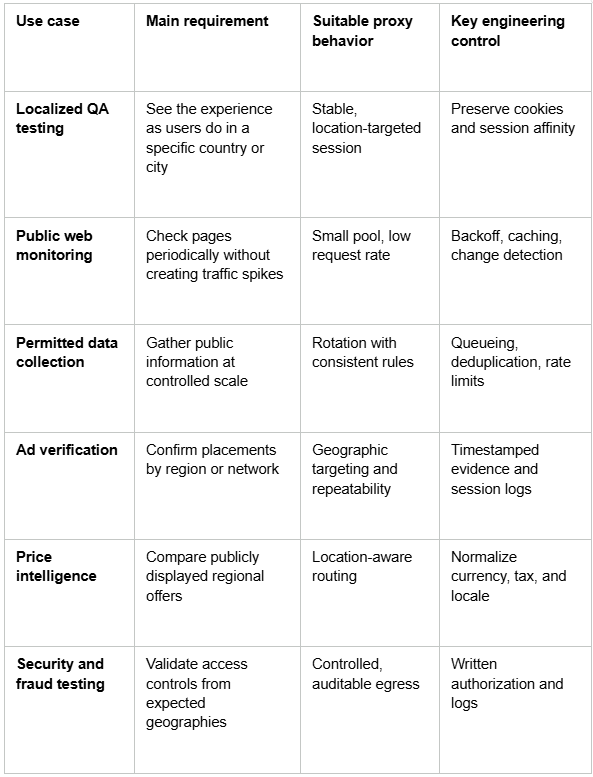
The table highlights an important point: rotation is not automatically better. Over-rotating can break sessions, increase verification challenges, and make troubleshooting harder. For workflows that require login persistence or a consistent user journey, a sticky session is often more useful than a new IP on every request.
Build Reliability Into the Pipeline
A proxy is only one component of a resilient system. The rest of the pipeline should be designed to handle uncertainty without becoming noisy or wasteful.
1. Use a queue and define idempotency
Every request should be safe to retry, or the pipeline should know how to detect a completed task before running it again. Store a request identifier, target URL, retrieval time, status code, proxy region, and content hash. That creates an audit trail and avoids collecting the same item repeatedly after a timeout.
2. Apply conservative rate limits
A 200 response does not prove a request rate is appropriate. Set per-domain concurrency limits, introduce jitter between requests, and use exponential backoff after errors such as 429, 503, or connection failures. Cache pages whenever the business question does not require real-time data.
A useful baseline is to begin with the minimum traffic needed for the task, then increase only after observing stable behavior and confirming that the workload is permitted.
3. Separate retryable failures from permanent ones
Not every failed request deserves a retry. A timeout, DNS error, or temporary 503 can be retried with backoff. A 404 may indicate the resource no longer exists. A repeated 401 or 403 may indicate that access is not authorized, in which case the correct response is to stop and investigate rather than rotate endlessly.
This distinction reduces unnecessary traffic and produces cleaner data.
4. Keep sessions intentional
Modern websites often depend on a combination of IP address, cookies, headers, browser state, and locale. If a workflow needs continuity, tie a session to one proxy endpoint for a defined period. If the workflow is stateless, rotate at a controlled interval and record the routing choice with the job metadata.
Services such as Rola IP are most useful when their geographic coverage, proxy categories, and session controls are mapped to these concrete requirements instead of treated as generic traffic capacity.
Match IP Characteristics to the Environment
Different IP sources create different operational tradeoffs.
Datacenter proxies are often fast and cost-efficient for tasks where network origin is not central to the result. They can be appropriate for approved testing, monitoring, or API-adjacent workloads, but some public sites scrutinize them more aggressively.
Residential proxies can provide a more typical consumer-network context for legitimate localization checks and public-web workflows. Because they represent a sensitive infrastructure category, teams should verify provider sourcing standards, consent practices, and acceptable-use policies before using them.
ISP proxies generally combine persistent addresses with network characteristics associated with consumer internet providers. They can be useful when a stable location matters over time.
The best choice is not the least expensive IP type or the largest advertised pool. It is the option that delivers the required geographic accuracy, consistency, observability, and policy alignment with the least operational complexity.
Observe the Pipeline Like a Production Service
Teams often monitor success rate but miss the signals that explain why it changes. A reliable proxy-enabled workflow should track:
Request success, timeout, and retry rates by target domain
HTTP status codes by country, proxy type, and session
Median and tail latency
Content-change rate and duplicate-response rate
Challenge or verification-page detection
Cost per usable record, not merely cost per request
Requests stopped because of policy, consent, or authorization concerns
These metrics make it possible to identify whether a decline comes from a target-site change, an expired session, a routing issue, a parser regression, or an overly aggressive schedule. They also provide evidence for operational decisions, which matters when a data pipeline supports pricing, research, compliance, or customer-facing systems.
Responsible Use Is a Reliability Advantage
The most durable data pipelines are not built around evasion. They are built around permission, restraint, and good engineering. Where an official API exists, it should normally be the first choice. Where access requires an account, license, or written authorization, obtain it. Do not collect personal data without a lawful basis, and do not use proxies to circumvent access controls, paywalls, or explicit restrictions.
This approach has a practical benefit: systems that respect boundaries are easier to maintain. They generate fewer adversarial responses, create clearer internal governance, and are less likely to become a long-term source of legal or operational risk.
Conclusion
Proxy IPs can improve reliability when they are part of a disciplined web-data architecture: define the permitted use case, choose the right session and location behavior, control request volume, classify failures intelligently, and monitor the entire workflow.
For developers, the real objective is not simply to make more requests. It is to produce dependable, explainable data with a system that remains useful when websites, regions, and network conditions change.
FAQs
What is the main benefit of proxy IPs in a web data pipeline?
They provide controlled routing options for location-specific testing, distributed permitted requests, and more resilient handling of single-IP rate limits or outages.
Should a pipeline rotate proxy IPs on every request?
Not necessarily. Stateless tasks may benefit from controlled rotation, while testing flows and session-dependent tasks often require a stable or sticky IP. The correct choice depends on the workflow.
Are proxies a replacement for rate limiting?
No. Rate limiting, caching, backoff, and concurrency controls remain essential. A proxy does not make excessive or unauthorized traffic acceptable.
How can developers evaluate a proxy provider?
Assess location coverage, available IP types, session controls, performance consistency, documentation, observability options, sourcing transparency, support quality, and acceptable-use policies.
When should a team use an API instead of proxies?
Use an official API whenever it meets the data requirement. APIs are usually more stable, more transparent, and easier to govern than browser-based collection.